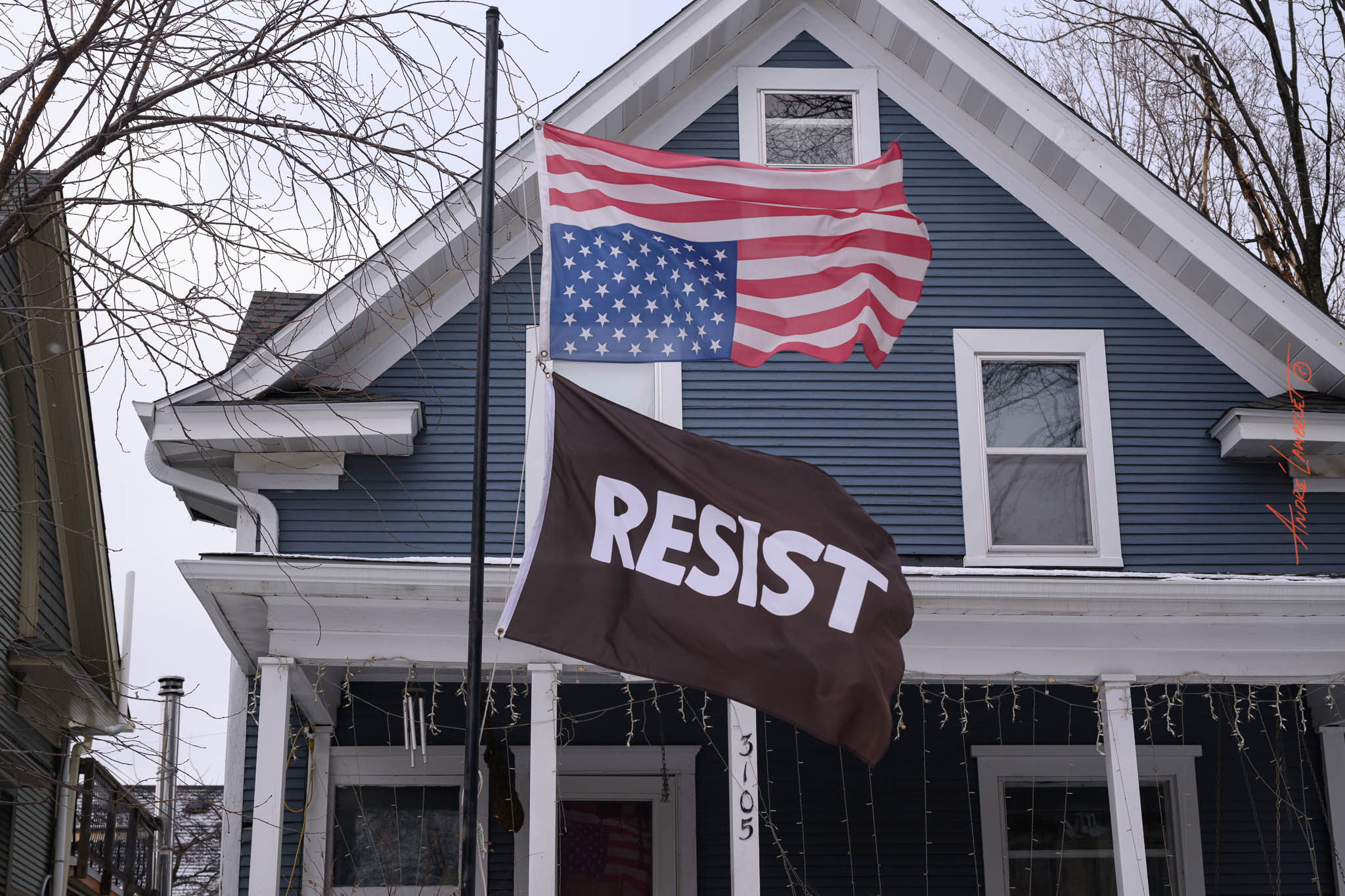
We have all had our fill of rage in the speeches and messages vomited forth by this regime. Last Tuesday’s State of the Union was an abomination. What it lacked in elegance it sought to make up in length; what it lacked in aspiration it sought to make up in vitriol.
Though we’ve become inured to the poverty of thought and the slackness of expression from this gibbering sack of petty grievances, spite, and hatred, we must remember that Americans are capable of greater things—and greater rhetoric.
At its best, political rhetoric reminds us of the grandeur of our ambitions, the humanity we share, and the collective effort we must undertake. There are countless examples to choose from, but this week I propose four classic expressions of American hope: Martin Luther King Jr.’s “I Have a Dream” speech; George Washington’s “Farewell Address”; Franklin Delano Roosevelt’s “First Inaugural Address” (“We have nothing to fear but fear itself”); and Dwight D. Eisenhower’s 1961 “Farewell Address” (the “Military-Industrial Complex” speech).
Please read at least a couple of these carefully. Consider what these speakers believed about human nature—and what they hoped America and Americans could become. And this time, bring a specific passage or two that you find especially powerful, whether for its political insight, its rhetorical craft, or simply the way it makes you feel about the country and its possibilities.
Let’s talk together about our aspirations for one another and for the United States.
We’ve all been struggling with a basic question: how do we explain the rise of the extremist right? Many of the answers we’ve come up with are deeply unsatisfying: incomplete, simplistic, or just not consistent with evidence.
But there’s some interesting work on the decline of what we might call pluralistic sociability: face-to-face contact with people. I’m spurred to think about this because I heard coverage of research by Hugo Subtil, a postdoctoral researcher in the Department of Political Science at the University of Zurich.
Subtil has been doing some fascinating work on the decline of the French café—the “bar/tabac.” (France24 has a brief discussion here; the full article—in French—is in the reading list below.) What he has sought to do is to make connections between the decline of these semi-public spaces and the rise of the extreme right in France. He writes,
Local democracy builds itself in the spaces where citizens encounter each other and form opinions on concrete interactions. [Translation mine].
By eliminating a place where people meet each other face to face, the decline of the café has eroded the social fabric, and the resulting isolation, alienation, and anomie lead seemingly inexorably to the far right.
That is a dreary lesson—but Subtil ends on a much more optimistic note.
The results… offer a glimmer of hope: public action can reverse this trend. Targeted interventions aimed at preserving or rebuilding local social infrastructure can help reduce support for the far right. The erosion of social cohesion is not inevitable.
So this month, as the public gathering of Minnesotans to resist the alienation imposed on this region by the federal government continues, I’d like to focus our attention on how meeting with strangers—in pubs, cafés, reading groups, churches—can help renew our sense of decency and kindness.
I’ve included a few readings: two research pieces, by Subtil and Diane Bolet, that focus on the decline of public spaces (cafés and pubs); a couple of newspaper accounts of those pieces; and a piece from the Financial Times that takes a look at the political philosopher Michael Sandel and his his focus on community.
Bolet, Diane. “Drinking Alone: Local Socio-Cultural Degradation and Radical Right Support—The Case of British Pub Closures.” Comparative Political Studies 54, no. 9 (August 1, 2021): 1653–92. https://doi.org/10.1177/0010414021997158. Download
Images from the “¡ICE OUT OF MINNESOTA! // ¡FUERA LA MIGRA DE MINNESOTA!” on January 10, 2026. Tens of thousands of people turned out to make it clear that ICE is not welcome here.
Yesterday, an ICE agent shot and killed a 37-year-old woman, Renee Good. Once again, ICE agents acted with callous disregard for the rights of the people they are sworn to protect. Once again, ICE agents used excessive force in the pursuit of an abominable policy.
People in Minneapolis responded. Thousands turned out for a vigil and demonstration. Those thousands were peaceful, somber, determined.
These are dark times. But there is solidarity here.
Our last meeting, on April 1, seems like it was years ago.
That day, we had glimmers of hope: Cory Booker was wrapping up his speech on the floor of the Senate, making the case, a plea, for a “moral moment,” even as we began our discussion of resistance.
A little closer to home, the last voters were casting their ballots in the most expensive judicial race in Wisconsin history—one marked by the extraordinary intervention of Elon Musk, who spent $20 million dollars to try to swing the election, not only by running a round-the-clock ad campaign, but also actually (and manifestly illegally) paying two voters a million dollars apiece in an attempt to pump up Republican turnout. Musk’s millions fared no better than a Cybertruck at the beach: Susan M. Crawford, the Democratic-backed candidate for the state Supreme Court, trounced the hard-right candidate, Brad Schimmel.
Though some of us were distracted by Booker’s oratory and the results that began to trickle in from Wisconsin, we tackled the question of resistance, and what it takes to get people to resist. We had read a short piece about resistance in wartime France, Martin Blumenson’s “The Early French Resistance in Paris“; part of the point of reading the piece was for us to think about the array of sometimes serious, sometimes banal issues that motivate people to resist; part of the point was how the resistance was in part fueled by the loutish, clueless insensitivity of the German occupiers:
If some people drifted into the work that as yet had no name, others were driven to it by what the Germans did. There was no dramatic event, no symbolic incident, but instead a series of minor irritations that gradually rubbed the French the wrong way (Blumenson, “Early Resistance”, 66).
Donald Trump and his cronies seem hellbent on emulating the German occupiers in this, as in many other regards. Insults to the dignity of the American people are a daily occurrence; worse, the cavalcade of assaults on the things that have actually made America great continue.
“Liberation Day”
On April 2, a day he bizarrely called “Liberation Day,” Donald Trump slapped tariffs on everyone and everything and everyplace, including, infamously, the Heard and McDonald Islands, home to a few penguins and zero people, and the British Indian Ocean Territory, which is best known as the home of a joint U.S./U.K. military base on the island of Diego Garcia. Stock markets reacted badly, not from sympathy to our flightless avian friends or our military personnel in the Indian Ocean, but to the specter of an all-out trade war with our biggest partners. Things weren’t helped by the incoherence of Trump’s tariffs nor by the idiocy of the justifications for these tariffs.
It took James Surowiecki, a financial journalist, less than no time to figure out how the tariffs had been calculated—and to post his analysis on X:
Just figured out where these fake tariff rates come from. They didn’t actually calculate tariff rates + non-tariff barriers, as they say they did. Instead, for every country, they just took our trade deficit with that country and divided it by the country’s exports to us. So we have a $17.9 billion trade deficit with Indonesia. Its exports to us are $28 billion. $17.9/$28 = 64%, which Trump claims is the tariff rate Indonesia charges us. What extraordinary nonsense this is.
It’s not always clear what will make some of our fellow Americans react to the havoc that Trump has inflicted on our country. But our erstwhile trading partners elsewhere struck back. Stock markets, predictably, plunged. If the abstract notion of a tariff had apparently left many Americans indifferent, the dawning realization that just about every business in America has a stake in international trade, and that every mom-and-pop operation that sells just about anything depends on at least one Chinese supplier began to cause some serious grumbling, and persuaded a scattering of Republicans to call for limits on presidential tariff authority.
I won’t go on to recap everything that’s happened; I’ve reached April 2, and I’ve already spent more words than I ought to have. What I do want to say, though, is that while there have been horror stories since our last meeting (the economy, the arbitrary arrest of green card holders, the forced exile of people deprived of due process, the arrest of a judge, attempts to squelch dissent within the federal government, Signalgate and its offspring, and so on), there are also signs that the minor and major irritations caused by the regime’s brutish actions are destroying the regime’s credibility. One sign was the massive turnout for protests on April 5 (some photos here; another sign is the shift in public opinion measured by national polls.
Trump’s approval ratings have crashed.
As CNN put it, “Trump’s 41% approval rating is the lowest for any newly elected president at 100 days dating back at least to Dwight Eisenhower – including Trump’s own first term.” And it’s not just CNN’s polling; every major poll shows a dramatic decline for Trump.
One of the most striking aspects of these polls is people who agree with Trump on some issues reject his regime’s methods. (The NYT/Siena Poll is particularly revealing on this. Take one example: 54% of people broadly agree with Trump’s anti-immigrant position; 52% also disapprove of the Kilmar Abrego Garcia expulsion to a Salvadorean prison.)
So what’s going on? One guess is that lots of people still do believe in basic rights and do not believe that “anything goes” to reach policy objectives. In other words, many (even most) people still have values.
It’s not just the polls
This isn’t just happening with public opinion, either. The record of resistance so far has been mixed and often disappointing (thanks, Columbia University!), but we’re beginning to see serious pushback from some universities (I never thought I would cheer for Harvard, but here we are), some law firms, many federal judges, and even small businesses. People are taking risks to defend what they think is right or to stave off what they think is wrong.
Understanding why people do and don’t take risks
In our previous discussions, we’ve tried to think about what democracy itself is (Abraham Lincoln, Susan B. Anthony, Pericles); why civic virtue matters (Montesquieu’s “Troglodyte Letters”); and the nature of (and slowness) of resistance (Blumenson).
For this meeting, the readings focus on responses (good and bad) to Trump. These include:
Columbia University’s announcement that it had caved to regime’s demands
Harvard’s reply to the regime’s demands (spoiler: it didn’t cave)
These responses—both courageous and cowardly—reveal something essential about resistance and civic virtue. We see a stark contrast between those who stood firm (Harvard, the federal judges, state attorneys general) and those who folded under pressure (Columbia, Paul Weiss). Neither group forms a monolithic bloc ideologically. Those who resist often disagree on policy, politics, and priorities. What unites them isn’t partisan alignment but commitment to fundamental values—due process, academic freedom, the rule of law, integrity of institutions. Similarly, those who capitulate don’t necessarily share politics but often share justifications: pragmatism, institutional survival, or claims of neutrality.
As we examine these readings, let’s consider these questions:
What makes some institutions hold firm while others capitulate?
What rationalizations enable people to abandon their proclaimed values when tested?
How can we recognize, resist, and debunk these justifications for inaction?
How do we nurture civic virtue in a polarized society?
Many thanks to Sandra Feist (www.feistlaw.com) for sharing this list of resources. Note that people can reach out to feistlaw.com for consultations if they have an employer interested in sponsoring them for a work visa or green card.
Member Directory for the American Immigration Lawyers Association – this website has a directory of attorneys who specialize in immigration, searchable by location: https://www.aila.org
Eva Rodelius and Kathleen KorniyenkoPhone: 612-913-4230Email: hello@casolaw.comWebsite: www.casolaw.com Family law and criminal law – familiar with immigration issues. Speaks Spanish