Blog

  • Legal Resources: Know Your Rights & Mobilization List

    Many thanks to Sandra Feist (www.feistlaw.com) for sharing this list of resources. Note that people can reach out to feistlaw.com for consultations if they have an employer interested in sponsoring them for a work visa or green card.

    Spanish language Legal Aid Know Your Rights: Pathways to Legal Status Webinar: 

    https://www.youtube.com/watch?v=UL6tHX6OTkg

    Welcoming America: Preparation & Raid Response for Immigrants & Community Allies:

    https://docs.google.com/document/d/1GgR8LTBqSA5RoCeaFkNNwRsOzsCnFY3P_OBp7O1tFhA/edit?tab=t.0

    Extensive Know Your Rights materials in multiple languages from the Immigrant Law Center of MN:

    Know Your Rights – simple videos in many languages:

    https://www.wehaverights.us

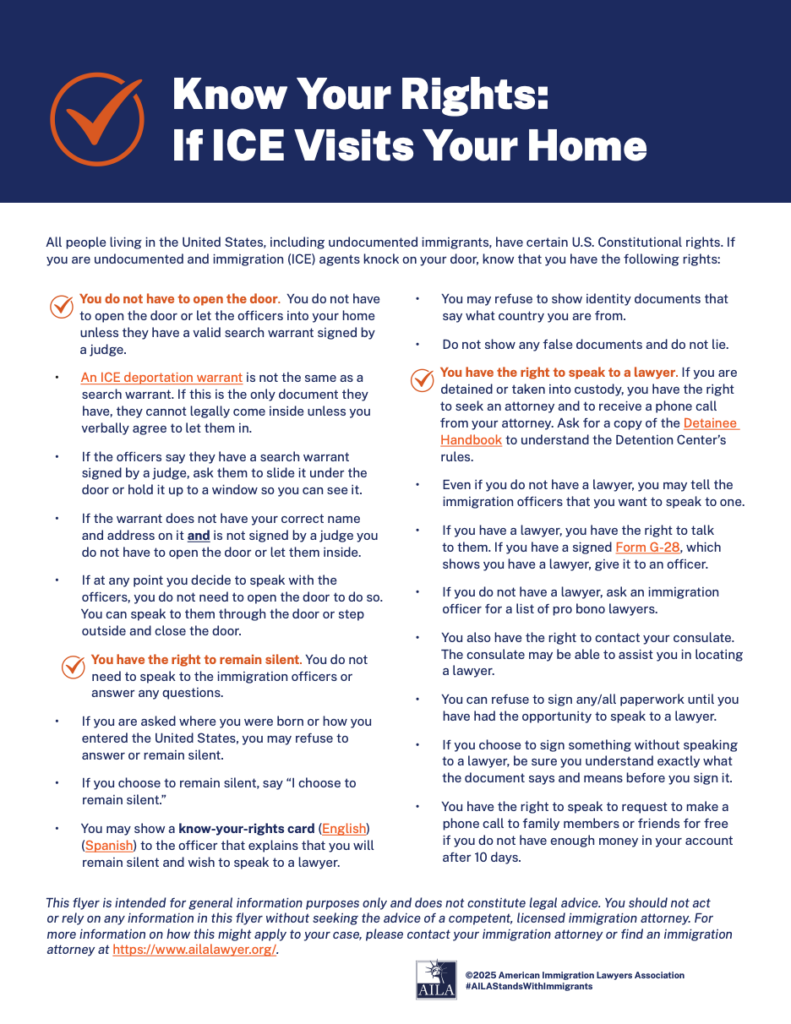
    AILA Know Your Rights document:

    For schools to create a safe and supportive environment for ELL students:

     https://www.mneep.org/toolkits/creating-safe-supportive-schools-for-immigrant-and-english-learner-el-students/

    Volunteer for the Advocates for Human Rights:

    https://www.theadvocatesforhumanrights.org/volunteer

    Volunteer for the International Institute of Minnesota

    https://iimn.org/volunteer/

  • Irresistible Fools

    Our next meeting is on April 1st. Really.

    In our first two meetings, we talked about the meaning of democracy and the nature of civic virtue. The theme this time will be resistance.

    Since we last met, the pace of the regime’s descent into authoritarianism has accelerated. We have seen this regime and its henchmen :

    • deport people it accuses of being “gang members” to El Salvador
    • defy federal court injunctions
    • arrest green card holders
    • detain, abuse and deport visitors to the United States
    • continue to escalate tensions with our closest international allies
    • use the White House as the setting for an ambush of the president of Ukraine
    • snuggle up to Putin
    • cut off weapons deliveries and and intelligence sharing to Ukraine
    • attempt to dismantle the Department of Education
    • silence the Voice of America
    • squelch dissenting voices on university campuses by extorting cooperation from pliant university administrators
    • bully law firms that represent(ed) people the regime does not like
    • impose a de facto “whites only” and “men only” policy in the celebration of American heroes
    • violate federal law by sharing classified documents about military actions on Signal

    And that, of course, is not even close to an exhaustive list—but it gives us an idea of why we feel so exhausted.

    We can group these into a few categories. This isn’t complete; it’s something we should think more about, but this is a start:

    • Attacks on people who oppose the regime
    • Attacks on people whom the regime despises
    • Attempts to eliminate institutional resistance
    • Substituting parastatal organizations (DOGE, MAGA) for the legally constituted institutions of the state
    • Attacks on the legal system in order to make it impossible to hold the regime accountable

    For the next meeting, I propose that we think about what effective resistance actually looks like. That means thinking about a number of different aspects of resistance; I propose that we decide at the beginning of our gather what we focus on. Here are some questions we might consider.

    • Who is most at risk?
    • How do we help people who are most in danger and most in need of support—those who have been directly targeted by the regime ((immigrants, people of color, women, LGBTQ+ people, people who stood up for the rule of law)?
    • How do we assess the risks of resistance—for ourselves and for others?
    • How do we make certain that people opposed to the regime can continue to communicate safely and openly?
    • How do we mitigate the risks of resistance?
    • How do we help institutions do better?
    • How do we help people understand the gravity of our situation?
    • How do we help people in government fulfill their obligations to protect the rights of all people?
    • How do we build for a better future?

    That’s a lot.

    This may all seem overwhelming, but there are many examples of resistance movements, some of which won outright: the anti-slavery movement in the United States, notably African-American resistance; desecration in post-war America; anti-colonial movements, especially in India; Yugoslav resistance to Nazi occupation; and French resistance during the Occupation.

    Despite the enormous range of things that we might look at, I’m recommending only one article, a short piece that’s freely available:

    Blumenson, Martin. “The Early French Resistance in Paris.” Naval War College Review 30, no. 1, Special Issue (1977): 64–72. https://www.jstor.org/stable/44641789

    I pick this not because France is a paradigm for successful resistance, but because it’s pretty digestible, it discusses the early stages of resistance in France, and, well, because it’s open access and thus readily available to anyone.

    Please get in touch if you need more information about the meeting. It’s at 7 pm, April 1, at the usual place. Please send an email to admin@firsttuesdayalliance.org if you need further information.

  • Notes on the March 4 Minneapolis meeting

    We had a good turnout at our Minneapolis meeting on March 4—a convivial group of newcomers and old hands—despite a winter storm that was beginning to rage.

    The topic our conversation was civic virtue. There was a broad consensus that we’re going through a period where people with power—and many who people who have very little power—feel unconstrained by ethics or concern for others.

    One of the challenges we face is rebuilding a sense of community and a sense of responsibility for the well-being of others. Simply meeting with new people who share an interest in building a community is a step , but we need much more. Many of the people who attended are already doing things, but finding out what to do, when to do it, where to do it all seem daunting.

    It’s important to recognize that rebuilding a community is hard—and it’s even harder when people are isolated. So talking to friends, neighbors, and even complete strangers can help. One of the people attending mentioned that she has made it a project to talk to people at the YWCA when she goes for her workouts, to let people know what role federal funds play in the work that organizations like the Y do.

    Another way to reach out is to share what we know and what we believe with others. Another small step is to engage with people in the state by writing letters to the editor. To that end, there’s a list of newspapers on the site now with contact information. You can retrieve all the daily papers simply by clicking a button—and begin writing.

    Some updates to the site: there’s the list of newspapers; there’s a new “group” feature that allows registered members to join a conversation; and the site should be a little cleaner. In the next few days, there will be a small documents / tools library that will include things like the readings we’ve done, templates for letters to the editor, and other useful things.

  • A Second First Tuesday: March 4, 2025

    Institutions Aren’t Enough: Troglodytes and the Role of Virtue in a Democracy

    The brutal assault on our democracy by Trump, Musk, and their confederates has made it clear that institutions aren’t enough. A democracy needs people who speak up, speak out, and do the right thing. Where do those people come from?

    The text to read for our next meeting on March 4 is a few pages from Montesquieu’s novel, Persian Letters. The letters we’ll read are allegorical: while they tell the story of the Troglodytes, a mythical people, they tackle the problems of virtue, society and law.

    Why Montesquieu?

    Charles de Secondat, Baron de Montesquieu was a towering figure of the French Enlightenment. A lawyer, scholar, and traveler, he was the author of one of the books most read and debated by American political thinkers in the tumult of the founding of the American republic. That book, The Spirit of the Laws, published in 1748, was credited with giving the founders of the American republic some of their most important insights about the nature of power and government.

    Opponents and proponents of the Constitution alike cited Montesquieu approvingly. James Madison, in Federalist LXVII, famously wrote,

    The oracle who is always consulted and cited on this subject is the celebrated Montesquieu. If he be not the author of this invaluable precept in the science of politics, he has the merit at least of displaying and recommending it most effectually to the attention of mankind.

    In our time, we all see the relentless and ruthless war on the separation of powers waged by a man who would be king. It’s important to remind ourselves of the importance of the legislative power and the indispensable role of a free judiciary.

    Persian Letters

    But Montesquieu was about more than the physics of government. He was interested in the world around him; he was curious about the origins of virtue—and the roots of vice. And he explored those questions in Persian Letters, one of the great novels of the early 18th century, published (anonymously) in 1723. This was an epistolary novel—that is to say, it was a series of letters (roughly 150) purportedly written by two Persians, Usbek and Rica, who leave their home of Isfahan in Persia to visit France. (We learn very early on in the novel that Usbek is forced to flee Persia because of palace intrigue.) Ribald, caustic, funny, erotic, and profound, the book was a smashing success.

    The Troglodytes letters are in the form of an allegory; you don’t need much background to make sense of them. Letter 10 sets them up: Usbek’s friend Mirza want to know about virtue:

    Yesterday the subject under discussion was whether men
    are made happy by pleasure, and the satisfaction of the senses, or by
    the practice of virtue. I have often heard you say that men were born
    to be virtuous, and that justice is a quality which is as proper to them
    as existence. Please explain to me what you mean.
    I have asked our mullahs about it, but they drive me to desperation
    with their quotations from the Koran: for I am not consulting them
    as a true believer, but as a man, as a citizen, and as a father.1

    There’s lots to glean from Usbek’s response, lots to think about—and, I believe, lots to learn about what we need to do to give new life to our civic virtue. Please read them carefully—and enjoy them!

    Discussion Questions about the Letters

    • What is the nature of (political) virtue?
    • Where does political virtue come from? (Are people born good?)
    • Is corruption a source of power?
    • How should we think about the rule of law?
    • How should we think about the relationship between religion and society?
    • Is altruism for suckers?

    From Ideas to Actions

    A note: Montesquieu wasn’t sitting in an ivory tower, musing about airy-fairy abstract notions. He was engaged in the politics of his region (Bordeaux) and the political life of his country (France). He travelled. He talked. He wrote. And he changed minds.

    The challenge for our discussion: how to turn what we talk about into action.
    1. Montesquieu, Persian Letters (Harmondsworth, UK: Penguin Books, 1993), 53. ↩︎
  • Notes on our first meeting

    About a dozen people joined us in Minneapolis on February 4. We had a spirited conversation — what does it mean to have a government of the people, by the people, and for the people? — discovered new allies, and took hope in our engagement. We were a diverse lot: people with lots of experience in politics; others with none. People with lots of experience with civil society; others with none.

    We’ll keep our conversation going; conversations like this help give us the courage to speak out and act. But we’re also working on sharing information about concrete things that people can do to help keep the flame of democracy lit. Soon, on this site, you’ll be able to find a searchable directory of resources, actions, and organizations that can help — and if you register, you’ll be able to contribute to that list. We’ll have an online forum to keep our conversations going, to share information about steps to take and to give people a space that isn’t run by people whose only interest is monetizing our conversations.

    If you’re interested in helping this effort, get in touch — you can fill out a contact form or simply send an email to admin@firsttuesdayalliance.org. We’ll get back to you quickly.

  • First Meeting: Tuesday, February 4, 2025

    Our first meeting will be held in Minneapolis on Tuesday, February 4, 2025, at 7 pm. (Sign up on the Contact list if you’re interested in coming and need the location.)

    We’ll be getting organized, talking about democracy and what it means, and thinking about practical steps to re-energize our community’s democratic spirit.

    There are three recommended readings for this initial meeting. None is required, but they’re all worthwhile. If you’re pressed for time, read the “Gettysburg Address” — and pay particular attention to the closing line.

    Suggested reading

    Susan B. Anthony, “Is it a crime for a U.S. citizen to vote?” (NOTE: The link published originally was wrong — this is the correct one!)

    Susan B. Anthony was arrested in 1872, in Rochester, New York, because she had voted in local elections in defiance of a law that restricted voting to “males.” It’s longer than the other suggested readings, but it rewards the effort of a close reading.

    Abraham Lincoln, “Gettysburg Address

    One of the most famous — and, at 267 words, one of the briefest — speeches in American political oratory. Lincoln gave it on November 19, 1863, at the height of the Civil War.

    Pericles, “Funeral Oration

    This was a speech given by (or attributed to) Pericles near the beginning of the Peloponnesian War between Athens and Sparta (and their many allies) from 404 BC and 431 BC. It’s often considered a classic exposition of the value of democracy.

  • Know Your Rights: the ILRC’s Red Cards

    https://www.ilrc.org/red-cards-tarjetas-rojas

    We’re in the first stages of a frenzied attempt by the new regime to fulfill the threats made during the Presidential campaign. Nevertheless, as the Immigrant Legal Resource Center (ILRC) declares,

    All people in the United States, regardless of immigration status, have certain rights and protections under the U.S. Constitution. The ILRC’s Red Cards help people assert their rights and defend themselves in many situations, such as when ICE agents go to a home.

    The ILRC offers cards with this message, free of charge to non-profits, printed on red card stock in Arabic, Chinese, English, Farsi, French, Haitian Creole, Hmong, Khmer, Korean, Pashto, Portuguese, Punjabi, Russian, Spanish, Tagalog, Tigrinya, Ukrainian, and Vietnamese– but they’ve been overwhelmed by demand.

    But they make the templates for these cards freely available on their website. You can download and print them yourself, or bring them to a print shop and have them do it. Here’s the link: https://www.ilrc.org/red-cards-tarjetas-rojas