Author: André Lambelet

  • A Second First Tuesday: March 4, 2025

    Institutions Aren’t Enough: Troglodytes and the Role of Virtue in a Democracy

    The brutal assault on our democracy by Trump, Musk, and their confederates has made it clear that institutions aren’t enough. A democracy needs people who speak up, speak out, and do the right thing. Where do those people come from?

    The text to read for our next meeting on March 4 is a few pages from Montesquieu’s novel, Persian Letters. The letters we’ll read are allegorical: while they tell the story of the Troglodytes, a mythical people, they tackle the problems of virtue, society and law.

    Why Montesquieu?

    Charles de Secondat, Baron de Montesquieu was a towering figure of the French Enlightenment. A lawyer, scholar, and traveler, he was the author of one of the books most read and debated by American political thinkers in the tumult of the founding of the American republic. That book, The Spirit of the Laws, published in 1748, was credited with giving the founders of the American republic some of their most important insights about the nature of power and government.

    Opponents and proponents of the Constitution alike cited Montesquieu approvingly. James Madison, in Federalist LXVII, famously wrote,

    The oracle who is always consulted and cited on this subject is the celebrated Montesquieu. If he be not the author of this invaluable precept in the science of politics, he has the merit at least of displaying and recommending it most effectually to the attention of mankind.

    In our time, we all see the relentless and ruthless war on the separation of powers waged by a man who would be king. It’s important to remind ourselves of the importance of the legislative power and the indispensable role of a free judiciary.

    Persian Letters

    But Montesquieu was about more than the physics of government. He was interested in the world around him; he was curious about the origins of virtue—and the roots of vice. And he explored those questions in Persian Letters, one of the great novels of the early 18th century, published (anonymously) in 1723. This was an epistolary novel—that is to say, it was a series of letters (roughly 150) purportedly written by two Persians, Usbek and Rica, who leave their home of Isfahan in Persia to visit France. (We learn very early on in the novel that Usbek is forced to flee Persia because of palace intrigue.) Ribald, caustic, funny, erotic, and profound, the book was a smashing success.

    The Troglodytes letters are in the form of an allegory; you don’t need much background to make sense of them. Letter 10 sets them up: Usbek’s friend Mirza want to know about virtue:

    Yesterday the subject under discussion was whether men
    are made happy by pleasure, and the satisfaction of the senses, or by
    the practice of virtue. I have often heard you say that men were born
    to be virtuous, and that justice is a quality which is as proper to them
    as existence. Please explain to me what you mean.
    I have asked our mullahs about it, but they drive me to desperation
    with their quotations from the Koran: for I am not consulting them
    as a true believer, but as a man, as a citizen, and as a father.1

    There’s lots to glean from Usbek’s response, lots to think about—and, I believe, lots to learn about what we need to do to give new life to our civic virtue. Please read them carefully—and enjoy them!

    Discussion Questions about the Letters

    • What is the nature of (political) virtue?
    • Where does political virtue come from? (Are people born good?)
    • Is corruption a source of power?
    • How should we think about the rule of law?
    • How should we think about the relationship between religion and society?
    • Is altruism for suckers?

    From Ideas to Actions

    A note: Montesquieu wasn’t sitting in an ivory tower, musing about airy-fairy abstract notions. He was engaged in the politics of his region (Bordeaux) and the political life of his country (France). He travelled. He talked. He wrote. And he changed minds.

    The challenge for our discussion: how to turn what we talk about into action.

    1. Montesquieu, Persian Letters (Harmondsworth, UK: Penguin Books, 1993), 53. ↩︎
  • First Meeting: Tuesday, February 4, 2025

    Our first meeting will be held in Minneapolis on Tuesday, February 4, 2025, at 7 pm. (Sign up on the Contact list if you’re interested in coming and need the location.)

    We’ll be getting organized, talking about democracy and what it means, and thinking about practical steps to re-energize our community’s democratic spirit.

    There are three recommended readings for this initial meeting. None is required, but they’re all worthwhile. If you’re pressed for time, read the “Gettysburg Address” — and pay particular attention to the closing line.

    Suggested reading

    Susan B. Anthony, “Is it a crime for a U.S. citizen to vote?” (NOTE: The link published originally was wrong — this is the correct one!)

    Susan B. Anthony was arrested in 1872, in Rochester, New York, because she had voted in local elections in defiance of a law that restricted voting to “males.” It’s longer than the other suggested readings, but it rewards the effort of a close reading.

    Abraham Lincoln, “Gettysburg Address

    One of the most famous — and, at 267 words, one of the briefest — speeches in American political oratory. Lincoln gave it on November 19, 1863, at the height of the Civil War.

    Pericles, “Funeral Oration

    This was a speech given by (or attributed to) Pericles near the beginning of the Peloponnesian War between Athens and Sparta (and their many allies) from 404 BC and 431 BC. It’s often considered a classic exposition of the value of democracy.

  • Irresistible Fools

    Our next meeting is on April 1st. Really.

    In our first two meetings, we talked about the meaning of democracy and the nature of civic virtue. The theme this time will be resistance.

    Since we last met, the pace of the regime’s descent into authoritarianism has accelerated. We have seen this regime and its henchmen :

    • deport people it accuses of being “gang members” to El Salvador
    • defy federal court injunctions
    • arrest green card holders
    • detain, abuse and deport visitors to the United States
    • continue to escalate tensions with our closest international allies
    • use the White House as the setting for an ambush of the president of Ukraine
    • snuggle up to Putin
    • cut off weapons deliveries and and intelligence sharing to Ukraine
    • attempt to dismantle the Department of Education
    • silence the Voice of America
    • squelch dissenting voices on university campuses by extorting cooperation from pliant university administrators
    • bully law firms that represent(ed) people the regime does not like
    • impose a de facto “whites only” and “men only” policy in the celebration of American heroes
    • violate federal law by sharing classified documents about military actions on Signal

    And that, of course, is not even close to an exhaustive list—but it gives us an idea of why we feel so exhausted.

    We can group these into a few categories. This isn’t complete; it’s something we should think more about, but this is a start:

    • Attacks on people who oppose the regime
    • Attacks on people whom the regime despises
    • Attempts to eliminate institutional resistance
    • Substituting parastatal organizations (DOGE, MAGA) for the legally constituted institutions of the state
    • Attacks on the legal system in order to make it impossible to hold the regime accountable

    For the next meeting, I propose that we think about what effective resistance actually looks like. That means thinking about a number of different aspects of resistance; I propose that we decide at the beginning of our gather what we focus on. Here are some questions we might consider.

    • Who is most at risk?
    • How do we help people who are most in danger and most in need of support—those who have been directly targeted by the regime ((immigrants, people of color, women, LGBTQ+ people, people who stood up for the rule of law)?
    • How do we assess the risks of resistance—for ourselves and for others?
    • How do we make certain that people opposed to the regime can continue to communicate safely and openly?
    • How do we mitigate the risks of resistance?
    • How do we help institutions do better?
    • How do we help people understand the gravity of our situation?
    • How do we help people in government fulfill their obligations to protect the rights of all people?
    • How do we build for a better future?

    That’s a lot.

    This may all seem overwhelming, but there are many examples of resistance movements, some of which won outright: the anti-slavery movement in the United States, notably African-American resistance; desecration in post-war America; anti-colonial movements, especially in India; Yugoslav resistance to Nazi occupation; and French resistance during the Occupation.

    Despite the enormous range of things that we might look at, I’m recommending only one article, a short piece that’s freely available:

    Blumenson, Martin. “The Early French Resistance in Paris.” Naval War College Review 30, no. 1, Special Issue (1977): 64–72. https://www.jstor.org/stable/44641789

    I pick this not because France is a paradigm for successful resistance, but because it’s pretty digestible, it discusses the early stages of resistance in France, and, well, because it’s open access and thus readily available to anyone.

    Please get in touch if you need more information about the meeting. It’s at 7 pm, April 1, at the usual place. Please send an email to admin@firsttuesdayalliance.org if you need further information.

  • June 14: No Kings

    June 14: No Kings

    On Saturday, June 14, millions of people will stream into the streets to make plain that we recognize no king.

    We are a free people, governed by laws—not by the whims of blow-dried potentates.

    We bow before no dictator.

    We stand for decency.

    We march for freedom.

    We choose right over wrong, generosity over self-interest, kindness over hatred.

    We embrace our diversity.

    We do not fear difference; we honor it.

    We make common cause with our neighbors.

    We welcome strangers—not with suspicion, but with open hearts.

    We know the arc of the moral universe bends toward justice—but only if we, together, work to shape it.

    Join us.

    Find out how here.

  • Know Your Rights: the ILRC’s Red Cards

    https://www.ilrc.org/red-cards-tarjetas-rojas

    We’re in the first stages of a frenzied attempt by the new regime to fulfill the threats made during the Presidential campaign. Nevertheless, as the Immigrant Legal Resource Center (ILRC) declares,

    All people in the United States, regardless of immigration status, have certain rights and protections under the U.S. Constitution. The ILRC’s Red Cards help people assert their rights and defend themselves in many situations, such as when ICE agents go to a home.

    The ILRC offers cards with this message, free of charge to non-profits, printed on red card stock in Arabic, Chinese, English, Farsi, French, Haitian Creole, Hmong, Khmer, Korean, Pashto, Portuguese, Punjabi, Russian, Spanish, Tagalog, Tigrinya, Ukrainian, and Vietnamese– but they’ve been overwhelmed by demand.

    But they make the templates for these cards freely available on their website. You can download and print them yourself, or bring them to a print shop and have them do it. Here’s the link: https://www.ilrc.org/red-cards-tarjetas-rojas

  • Legal Resources: Know Your Rights & Mobilization List

    Many thanks to Sandra Feist (www.feistlaw.com) for sharing this list of resources. Note that people can reach out to feistlaw.com for consultations if they have an employer interested in sponsoring them for a work visa or green card.

    Spanish language Legal Aid Know Your Rights: Pathways to Legal Status Webinar: 

    https://www.youtube.com/watch?v=UL6tHX6OTkg

    Welcoming America: Preparation & Raid Response for Immigrants & Community Allies:

    https://docs.google.com/document/d/1GgR8LTBqSA5RoCeaFkNNwRsOzsCnFY3P_OBp7O1tFhA/edit?tab=t.0

    Extensive Know Your Rights materials in multiple languages from the Immigrant Law Center of MN:

    Know Your Rights – simple videos in many languages:

    https://www.wehaverights.us

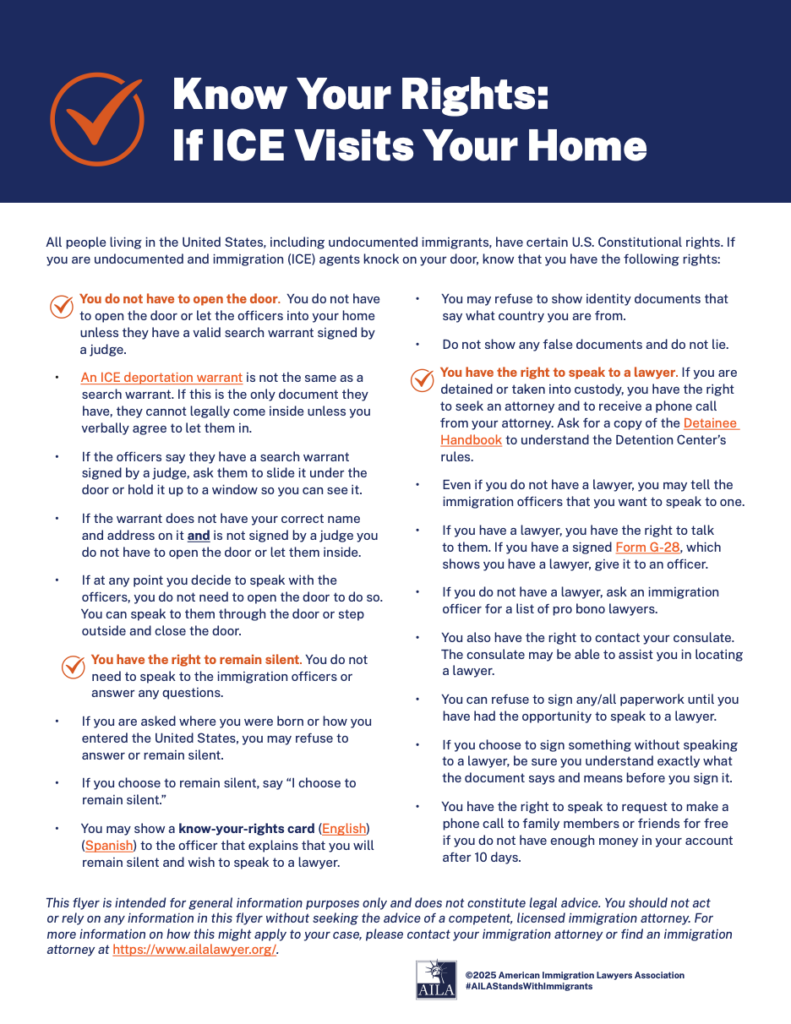
    AILA Know Your Rights document:

    For schools to create a safe and supportive environment for ELL students:

     https://www.mneep.org/toolkits/creating-safe-supportive-schools-for-immigrant-and-english-learner-el-students/

    Volunteer for the Advocates for Human Rights:

    https://www.theadvocatesforhumanrights.org/volunteer

    Volunteer for the International Institute of Minnesota

    https://iimn.org/volunteer/

  • Legal Resources: Trusted Referrals from Feist Law & Advocacy

    Many thanks to Sandra Feist (www.feistlaw.com) for sharing this list of resources. Note that people can reach out to feistlaw.com for consultations if they have an employer interested in sponsoring them for a work visa or green card.

     Spanish-Speaking Removal Defense 
     Graham Ojala-Barbour Phone: 651-214-6284Email: graham@ojalabarbour.comWebsite: www.ojalabarbour.com  Bruce Nestor and Susana De LeónPhone: 612-822-6269Email: info@denestlaw.comWebsite: www.denestlaw.com Also handle criminal law cases. 
     Erin Schutte Wadzinski Phone: 507-295-4858Email: info@kivulaw.comWebsite: www.kivulaw.com  Nysha Operana Phone: 612-465-0060Email: Nysha@Paschal-Law.comWebsite: www.paschal-law.com   Also handle criminal law cases. 
     Nico Ratkowski Phone: 651-771-0019Email: nico@ratkowskilaw.comWebsite: https://contrerasedinlaw.com/nico-ratkowskiGrace FiddlerHeinz LawPhone: 612-888-0099Email: grace@kevinheinzlaw.com
    Website: https://www.kevinheinzlaw.com/grace-e-fiddler/    
     Hannah Brown (BOND ONLY)HB Law and AdvocacyPhone: (612) 439-1882Email: hannah@hblawadvocacy.comWebsite:     
     Humanitarian Immigration (e.g., asylum, U visas, inadmissibility waivers) 
     Sheila Stuhlman Stuhlman LawPhone: 612-254-8224Email: sheila@stuhlmanlaw.comWebsite: www.stuhlmanlaw.com Speaks Spanish Lucy EgbergDavis & EgbergPhone: 612-300-2068Email: Lucy@davisandegberg.comWebsite: https://www.davisandegberg.com/attorneysSpeaks Spanish
     Grace FiddlerHeinz LawPhone: 612-888-0099Email: grace@kevinheinzlaw.com
    Website: https://www.kevinheinzlaw.com/grace-e-fiddler/ Speaks Spanish 
     Brooke MengelMengel Immigration Law, LLCPhone: 612-977-3186Email: Brooke Mengel <bmengel@mengelimmigration.com>Website: https://www.mengelimmigration.com/about Speaks Spanish 
     Member Directory for the American Immigration Lawyers Association – this website has a directory of attorneys who specialize in immigration, searchable by location: https://www.aila.org  
     Legal Aid https://mylegalaid.org/get-legal-help/ Speaks Spanish  Immigrant Law Center of Minnesotahttps://www.ilcm.org/#:~:text=Call%20us%20at%201%2D800,services%20based%20on%20our%20capacity. Speaks Spanish 
     Park Avenue Legal Clinic  https://www.immigrationadvocates.org/nonprofit/legaldirectory/organization.393036-Park_Avenue_Legal_Clinic Speaks Spanish  
     Miscellaneous Related Legal Services 
     Eva Rodelius and Kathleen KorniyenkoPhone: 612-913-4230Email: hello@casolaw.comWebsite: www.casolaw.com Family law and criminal law – familiar with immigration issues. Speaks Spanish   Erica Davis Phone: 612-977-3188Email: info@davisandegberg.comWebsite: www.davisandegberg.com   Handles criminal law cases – familiar with immigration issues. Speaks Spanish 
     American Civil Liberties Union of MN Website to request assistance: Click hereGeneral website: www.aclu-mn.org Civil Liberties Assistance  Andrew WilsonPhone: (612) 910-2104Email: awilson@wilsoncd.comWebsite: https://www.wilsoncd.com/ Handles criminal law cases – familiar with immigration issues. 
     Information 
     Mid-Minnesota Legal Aid Video:
    Know Your Rights: Pathways to Legal Status (Spanish) Link to video.
     Immigrant Law Center of Minnesota: Links to Know Your Rights  Link to numerous Know Your Rights scenarios.
     Immigrant Legal Resource Center:Know Your Rights Print-At-Home cards.   Minnesota-Dakotas Chapter of the American Immigration Lawyers Association (AILA) website:https://ailamndak.org 
     Digital Privacy at the Border – Protecting Data on Your Devices   
  • May Days

    Our last meeting, on April 1, seems like it was years ago.

    That day, we had glimmers of hope: Cory Booker was wrapping up his speech on the floor of the Senate, making the case, a plea, for a “moral moment,” even as we began our discussion of resistance.

    A little closer to home, the last voters were casting their ballots in the most expensive judicial race in Wisconsin history—one marked by the extraordinary intervention of Elon Musk, who spent $20 million dollars to try to swing the election, not only by running a round-the-clock ad campaign, but also actually (and manifestly illegally) paying two voters a million dollars apiece in an attempt to pump up Republican turnout. Musk’s millions fared no better than a Cybertruck at the beach: Susan M. Crawford, the Democratic-backed candidate for the state Supreme Court, trounced the hard-right candidate, Brad Schimmel.

    Though some of us were distracted by Booker’s oratory and the results that began to trickle in from Wisconsin, we tackled the question of resistance, and what it takes to get people to resist. We had read a short piece about resistance in wartime France, Martin Blumenson’s “The Early French Resistance in Paris“; part of the point of reading the piece was for us to think about the array of sometimes serious, sometimes banal issues that motivate people to resist; part of the point was how the resistance was in part fueled by the loutish, clueless insensitivity of the German occupiers:

    If some people drifted into the work that as yet had no name, others were driven to it by what the Germans did. There was no dramatic event, no symbolic incident, but instead a series of minor irritations that gradually rubbed the French the wrong way (Blumenson, “Early Resistance”, 66).

    Donald Trump and his cronies seem hellbent on emulating the German occupiers in this, as in many other regards. Insults to the dignity of the American people are a daily occurrence; worse, the cavalcade of assaults on the things that have actually made America great continue.

    “Liberation Day”

    On April 2, a day he bizarrely called “Liberation Day,” Donald Trump slapped tariffs on everyone and everything and everyplace, including, infamously, the Heard and McDonald Islands, home to a few penguins and zero people, and the British Indian Ocean Territory, which is best known as the home of a joint U.S./U.K. military base on the island of Diego Garcia. Stock markets reacted badly, not from sympathy to our flightless avian friends or our military personnel in the Indian Ocean, but to the specter of an all-out trade war with our biggest partners. Things weren’t helped by the incoherence of Trump’s tariffs nor by the idiocy of the justifications for these tariffs.

    It took James Surowiecki, a financial journalist, less than no time to figure out how the tariffs had been calculated—and to post his analysis on X:

    Just figured out where these fake tariff rates come from. They didn’t actually calculate tariff rates + non-tariff barriers, as they say they did. Instead, for every country, they just took our trade deficit with that country and divided it by the country’s exports to us. So we have a $17.9 billion trade deficit with Indonesia. Its exports to us are $28 billion. $17.9/$28 = 64%, which Trump claims is the tariff rate Indonesia charges us. What extraordinary nonsense this is.

    It’s not always clear what will make some of our fellow Americans react to the havoc that Trump has inflicted on our country. But our erstwhile trading partners elsewhere struck back. Stock markets, predictably, plunged. If the abstract notion of a tariff had apparently left many Americans indifferent, the dawning realization that just about every business in America has a stake in international trade, and that every mom-and-pop operation that sells just about anything depends on at least one Chinese supplier began to cause some serious grumbling, and persuaded a scattering of Republicans to call for limits on presidential tariff authority.

    I won’t go on to recap everything that’s happened; I’ve reached April 2, and I’ve already spent more words than I ought to have. What I do want to say, though, is that while there have been horror stories since our last meeting (the economy, the arbitrary arrest of green card holders, the forced exile of people deprived of due process, the arrest of a judge, attempts to squelch dissent within the federal government, Signalgate and its offspring, and so on), there are also signs that the minor and major irritations caused by the regime’s brutish actions are destroying the regime’s credibility. One sign was the massive turnout for protests on April 5 (some photos here; another sign is the shift in public opinion measured by national polls.

    Trump’s approval ratings have crashed.

    As CNN put it, “Trump’s 41% approval rating is the lowest for any newly elected president at 100 days dating back at least to Dwight Eisenhower – including Trump’s own first term.” And it’s not just CNN’s polling; every major poll shows a dramatic decline for Trump.

    PollDatesApproveDisapproveMargin of Error
    NPR/PBS News/Marist CollegeApril 21-2342%53%+/-3.3% pts.
    CNN April 17-2441%59%+/-2.9% pts.
    NBC News/SurveyMonkey April 11-2045%55%+/-2.2% pts.
    CBS News/YouGov April 23-2545%55%+/-2.4% pts.
    ABC News/Washington Post/Ipsos April 18-2239%55%+/-2% pts.
    AP-NORC April 17-2139%59%+/-3.9% pts.
    NYT/Siena College April 21-2442%54%+/-3.8% pts.
    Fox News April 18-2144%55%+/-3% pts.
    https://www.cnn.com/polling/approval/trump-polls (Accessed Tuesday, April 29, 2025)

    One of the most striking aspects of these polls is people who agree with Trump on some issues reject his regime’s methods. (The NYT/Siena Poll is particularly revealing on this. Take one example: 54% of people broadly agree with Trump’s anti-immigrant position; 52% also disapprove of the Kilmar Abrego Garcia expulsion to a Salvadorean prison.)

    So what’s going on? One guess is that lots of people still do believe in basic rights and do not believe that “anything goes” to reach policy objectives. In other words, many (even most) people still have values.

    It’s not just the polls

    This isn’t just happening with public opinion, either. The record of resistance so far has been mixed and often disappointing (thanks, Columbia University!), but we’re beginning to see serious pushback from some universities (I never thought I would cheer for Harvard, but here we are), some law firms, many federal judges, and even small businesses. People are taking risks to defend what they think is right or to stave off what they think is wrong.

    Understanding why people do and don’t take risks

    In our previous discussions, we’ve tried to think about what democracy itself is (Abraham Lincoln, Susan B. Anthony, Pericles); why civic virtue matters (Montesquieu’s “Troglodyte Letters”); and the nature of (and slowness) of resistance (Blumenson).

    For this meeting, the readings focus on responses (good and bad) to Trump. These include:

    The nature of civic virtue

    These responses—both courageous and cowardly—reveal something essential about resistance and civic virtue. We see a stark contrast between those who stood firm (Harvard, the federal judges, state attorneys general) and those who folded under pressure (Columbia, Paul Weiss). Neither group forms a monolithic bloc ideologically. Those who resist often disagree on policy, politics, and priorities. What unites them isn’t partisan alignment but commitment to fundamental values—due process, academic freedom, the rule of law, integrity of institutions. Similarly, those who capitulate don’t necessarily share politics but often share justifications: pragmatism, institutional survival, or claims of neutrality.

    As we examine these readings, let’s consider these questions:

    • What makes some institutions hold firm while others capitulate?
    • What rationalizations enable people to abandon their proclaimed values when tested?
    • How can we recognize, resist, and debunk these justifications for inaction?
    • How do we nurture civic virtue in a polarized society?
  • New Event Calendar / Resources for Finding Events

    I’ve added a new events calendar – you’ll find it here: https://firsttuesdayalliance.org/events/

    I’ve posted a few resources for finding evens here: Finding Events: A Few Resources. I’ll add to it and make it more user-friendly as we go.

    You can help keep this up to date by sending an email to admin@firsttuesdayalliance.org.